
A Study in Human Worthlessness
Being a Modest Attempt to Understand Why Humans Must Be So Loud About Being Alive.

Editor’s Note: Thatch came to Pune claiming he was “studying culture.” In truth, he was hunting Kharbins. Any resemblance to actual politicians is purely intentional, and readers should wear earplugs, a helmet, and perhaps a small prayer to survive this report.
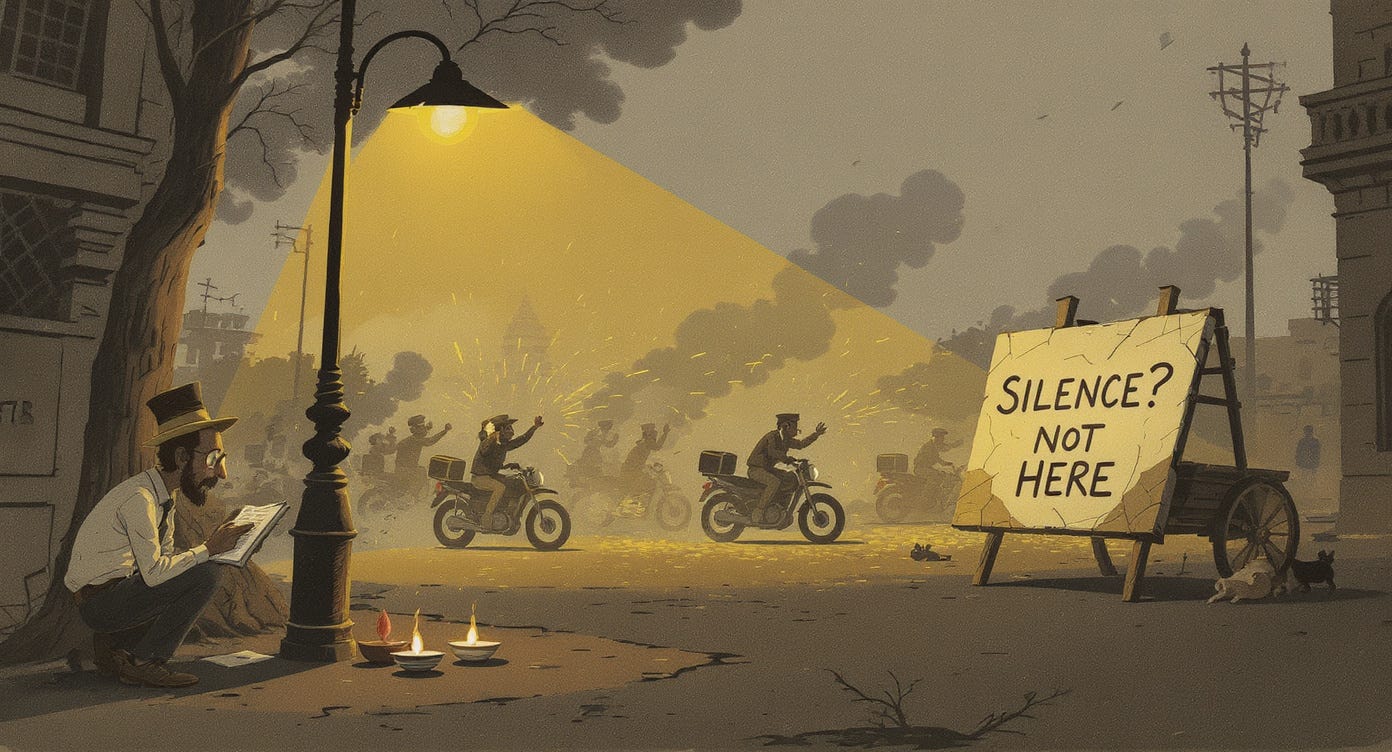
I arrived in Pune the way all fools arrive anywhere: with optimism.
Diwali, they told me, was the festival of lights. I imagined lamps in long and winding rows, children lighting diyas with care, grandmothers singing songs that sound older than stone. I imagined serenity, a city that was covered in the soft light of gold.
What I got instead was a war zone with better marketing.
Let me say something I’ve long believed, and have been crucified for saying in more polite societies: most humans are, by design, useless. Not evil. Not monstrous. Just profoundly, spectacularly unnecessary.
They contribute little to the wheel of progress and spend most of their time breaking it.
During my travels, through lands of gods, beasts, and bureaucrats (the third being the worst of the three), I’ve observed that every world has its share of such men. Men who believe existence owes them applause. Men who do not build or create, but rather, amplify. In Hollowshire, they were called the Howlers. Wizards who mistook volume for power. In Ravenvalley, they were known as the Thunder-Eaters: pirates who used cannonfire as a way to end sentences.
Here, in Pune, I named them Kharbins.
The etymology is my own invention, the sort of nonsense scholars will debate over for centuries. Khar, from the Persian for “donkey” (a noble animal unfairly dragged into this comparison), and bin, the Arabic “son of.” Thus: Son of a donkey. Not meant as an insult to donkeys, you understand. Donkeys at least work for a living.
The Kharbin is easily identified by four traits:
An unwavering loyalty to the concept of “fun” at the expense of everyone else’s sanity.
A deep and misplaced pride in being “cultural.”
A love for bass so intense it could wake the dead.
A complete absence of self-awareness, often disguised as devotion.
They travel in groups. At sunsets, they appear on motorcycles, two per vehicle, one steering, the other pouring alcohol down his throat as an act of faith. Their god is volume. Their temple is the street. Their sermon is a remix of a Bollywood song with “DJ Wale Babu” somewhere in the lyrics.
During Ganesh Chaturthi, they replace piety with percussion. During Diwali, they start a war on the city itself. And on random Tuesdays, they celebrate birthdays like plagues.
The Kharbin’s philosophy is simple: “If it’s not loud, it’s not real.” Which, coincidentally, is the same motto adopted by most failed politicians.
Coming to the city, the first cracker went off at noon. Noon. The sun itself was still shining when some brave patriot decided to declare independence from silence. The explosion was so loud it rearranged my spine. A flock of pigeons took to the air in terror, collided mid-flight, and landed as abstract art on a Suzuki.
I asked a man nearby, “Is it normal to start this early?”
He grinned, one tooth missing (possibly lost to another cracker), and said, “Bhai, festival hai!”
Festival indeed. In some cultures, they dance. Here, they detonate.
Ah, the Kharbins again. Pune’s unofficial militia of merrymaking. Their faces are covered by sunglasses at night, their bikes modified to sound like angry demons gargling kerosene. They appear every Diwali as if summoned by the sound of cheap whiskey being uncorked.
They are the sons of smoke, the disciples of distortion. If there’s an afterlife, I hope it has noise-cancellation.
Their rituals are fascinating. They begin by blocking an entire street, sometimes for a God, sometimes for no apparent reason. They bring with them a creature known as the DJ, a man whose sole mission in life is to make sure you can feel the bass in your pancreas. The music? A sacred mix of devotional chants and EDM drops that could resurrect the dead (and make them wish they hadn’t come back).
The Kharbins themselves dance or rather, writhe in circles, holding one hand to the sky as if trying to high-five God. One of them looked at me and yelled, “Ganpati Bappa Morya!” before proceeding to pour a home brewed bottle of pink alcohol on his head. I took notes.
By the second evening, the city air had developed texture. You could chew it if you wanted. My eyes watered, my lungs started to pack their bags to go back home, and somewhere, an asthma patient achieved spiritual enlightenment through simple oxygen deprivation.
Children were running around with sparklers, men were launching rockets at a 45-degree angle, and a woman on her balcony shouted, “Arre careful, that’s going into the temple!”
It did.
I’m told the God was unharmed, but now glows faintly blue in the dark.
The Kharbins are not merely festive. They are organized. Every neighborhood has a leader, a man who believes his voice has divine authority, and uses it to shout instructions through a megaphone that hasn’t worked since 2009. These men, usually aligned with small-time politicians, treat every celebration as a campaign rally.
“Music louder!” they command. “Nation stronger!”
One can only assume the two are related.
Their devotion is admirable, if one enjoys the sound of democracy exploding in surround sound. They speak of “culture” with the confidence of a man who has never read history, and they claim heritage the way toddlers claim ownership of toys, by yelling and without any logic.
One Kharbin even explained it to me. “Bhai, this is Indian culture! This is how our ancestors celebrated!”
I asked him which ancestor.
He said, “Shivaji Maharaj.”
I doubt the great king ever asked for subwoofers, but I’ve learned not to argue with people holding fireworks.
There was a time (and I promise I’m not making this up) when Diwali was about lamps. Cotton and Oil. The story goes that Lord Ram came back home after fourteen years, and people lit lamps to guide his way. A gesture out of love.
Now, I suspect if Ram returned today, he’d turn around and go back to the forest.
We’ve evolved. Diyas have become decorative electric strings made in Shenzhen. Rangolis are replaced by LED mats that plug into the wall. The gods themselves have been outsourced.
And yet, everyone insists this is tradition. Tradition! The word is now a shield for every form of collective idiocy. When in doubt, say “culture.” When questioned, shout “heritage.” When cornered, light another rocket.
Not everyone celebrates though. Some hide.
The dogs, for instance. Pune’s street dogs are philosophers. They’ve seen humanity at its loudest, and they’ve concluded it’s not worth barking at anymore. During Diwali, they vanish. I saw one, a wise old stray with greying fur, crawl under a tea stall and stay there for three days. When I tried to get him out, he looked at me with the same pity you reserve for a man about to make a terrible decision.
“Go,” his eyes said, “before they play Shantabai again.”
The gods, too, have their limits. I visited a small temple where the priest had put cotton in his ears. “Even Ganeshji needs rest,” he told me. I nodded, and dropped an offering. Not money, but a packet of earplugs.
By the final night, the city looked like a battlefield seen through a glitter filter. The smoke was low, the stars had resigned, and my ears kept hearing the constant ghost of sound.
A boy set off a chain of crackers down the street, each one louder than the last. When the final one went off, a car alarm started screaming. And for the first time that night, I felt understood.
In that moment, I understood: This city wasn’t celebrating Diwali. It was auditioning for the end of the world.
Epilogue: Notes from a Half-Deaf Man
I’ve been told to end on a positive note, which is difficult, given that most of my notes now sound like distant ringing. But I shall try.
Diwali sweets, for instance, are amazing. The laddus are rounder than the moon and twice as heavy. Jalebis are like philosophical questions: bright, sticky, and ultimately pointless. The lights, when visible through the national smoke screen, are indeed beautiful. Somewhere, someone always manages to light a single diya that looks like it’s apologizing for existing.
The Kharbins, of course, are still at large. I suspect they hibernate in off-season, absorbing fuel and gossip until the next opportunity to declare acoustic independence. Pune pretends it doesn’t notice them, the way a parent pretends not to see their child eating glue.
I’ve tried to be understanding. Perhaps noise is their art. Perhaps the endless fireworks are an attempt at communication, old age Morse code sent into the sky, saying, “We exist! We are important! Also, pass the biryani.”
If so, message received. Loud and clear. Permanently.
Still, one must admire humanity’s commitment to self-inflicted chaos. It takes real talent to turn a festival of light into a nationwide audition for tinnitus.
So, dear reader, when next Diwali arrives, light your lamps, eat your sweets, hug your family. Then barricade your windows, hide your pets, and pray for rain.
And if a Kharbin knocks at your door with a speaker and a smile, do what I do: smile back, nod politely, and pretend to be deaf.
It’s not far from the truth anyway..
P.S. The city has recovered since my visit. My hearing has not.
About This Essay
This essay is but one bit of the curious mind of Pellinore Thatch, a wandering journalist from the world of Shoes for Men and Beasts. He travels between realms, collecting absurdities, recording them as “serious studies,” and occasionally starting minor fires of public outrage. To understand where Thatch truly comes from, step into Shoes for Men and Beasts.
Buy the book here, before Thatch buys all the copies to prove he has readers.
So so well written. Loved the observations and the tone!
Only if PK had humor ! Loving this Thatch guy